





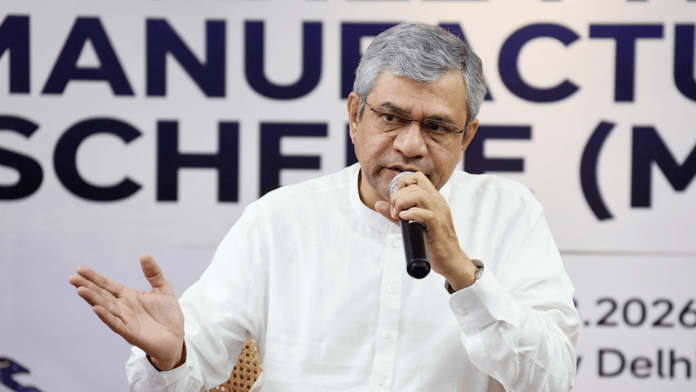

New Delhi: The government expects Apple to manufacture products beyond the iPhone in India and Google to move most of its export-oriented production out of China and to the country, Electronics and IT Minister Ashwini Vaishnaw said Friday as the Centre notified a Rs 62,500-crore scheme to extend incentives for mobile phone manufacturing.
Asked whether Apple could make more than iPhones in the country, Vaishnaw replied “yes”, and said the government was in talks with the company to broaden the range of products it assembles in India. On Google, he said India is expected to take a large share of the output the company currently routes through China for overseas markets.
Vaishnaw put the scale of the shift in numbers. “Mobile phone production, cumulative, which was about 22 lakh crore, will be doubling in this period. It will go up to 40 lakh crore,” he said. “That’s a big, big thing.”
On smartphones, which he noted were the country’s largest single export last year, Vaishnaw said: “…that position will be retained, that position will be further strengthened”, and electronics, now the third-largest export category, would keep its ranking.
The government is separately working with three Indian companies that could grow into smartphone brands over the next 10-14 months, the minister said. The three have been asked to draw up best-in-segment designs and pick the product categories they intend to compete in, he said, adding that each firm’s intellectual property and design would be assessed before any support was cleared.
The Mobile Phone Manufacturing Scheme (MPMS), cleared by the Cabinet in July, runs from 2026-27 to 2030-31. It picks up from the production-linked incentive (PLI) scheme for large-scale electronics manufacturing that closed on 31 March, and tilts the policy towards components and higher domestic value addition, after the earlier round rewarded manufacturers mainly for building volume.
Payouts under the scheme range from 2.25 to 5 per cent of eligible mobile phone sales. Firms can earn up to 1.5 per cent more for sourcing components and sub-assemblies at home—display and camera modules, enclosures, batteries and USB cables—provided they localise those parts for at least a quarter of the handsets they sell in a year.
The scheme splits into two tracks. One is open to manufacturers, including contract manufacturers, that booked at least Rs 10,000 crore in turnover in 2025-26. The second is reserved for Indian brands and adds a 3 per cent incentive for design and R&D done in the country. To count as an Indian brand, a company must keep its trademark and IP in India, be controlled by Indian citizens holding more than 51 per cent of the entity, and run its own design and research here. Such brands face no minimum sales bar and will be picked by an inter-ministerial committee chaired by the MeitY Secretary.
Apple has assembled iPhones in India since 2017 and has scaled up through suppliers such as Foxconn and the Tata Group. Counterpoint Research estimates, cited by Reuters, put India’s share of global iPhone output at roughly 26 per cent this year, and much of the Foxconn plants’ Indian output is shipped to the United States. The company also makes some components locally alongside final assembly.
Google said in October 2023 that it would build Pixel phones in India, starting with the Pixel 8, using partners including Dixon Technologies. This week, reports said the company intends to end production of Pixel phones, watches and earbuds in China from 2027 and shift it to India and Vietnam. Google has not confirmed the move.
By the government’s count, 99.2 per cent of the phones used in India are now made in the country, and domestic value addition in the sector touched 23 per cent in 2023-24. Figures shown at the briefing traced a 33-fold rise in mobile phone production and a 166-fold jump in exports since 2014-15, taking India to second place worldwide in handset output by volume.
Smartphones, absent from India’s 100 biggest export items a decade ago, topped the list in 2025-26. Over the same stretch, the government said, mobile phones’ share of electronics manufacturing climbed to 48 per cent from about 10 per cent, and their share of electronics exports to 61 per cent from around 4 per cent.
The outlay is capped and will be divided between the two tracks according to demand, with companies allowed to file claims every quarter. Detailed guidelines will follow separately from the Ministry of Electronics and IT.
(Edited by Gitanjali Das)
Also Read: What is the antitrust case against Apple & why has Delhi HC allowed CCI probe but paused final order